Sunday, February 17, 2013
Loss ("My Brother's Book" by Maurice Sendak)
One of the greatest interviews I've ever seen took place only a few years ago between Maurice Sendak and Stephen Colbert for the latter's television show. Broadcast over two nights--three if you include clips broadcast the night after Sendak's death--the interview was noteworthy for more than a few reasons, the most important being the similarities both men shared. Yes, they were separated by decades--Sendak was in his 80s at the time and visibly ill, while Colbert was in his forties--as well as by backgrounds and careers. After all, Sendak was gay, Jewish, and from a small family, whereas Colbert grew up one of 11 children in a Catholic home. But they were also two men who found serious faults in the world in which they lived and chose to express their anger, frustration, and overall disappointment with humanity in different ways. Colbert took to satire, and four weeks a night he lampoons the thoughtless, compassionless, hypocritical, and megalomaniacal members of our society, often found in positions of great power and influence, by imitating their brazen selfishness and egotism to the point of hyperbole. Sendak, on the other hand, chose to be thoughtful, compassionate, and humble towards those who had the least amount of power and influence in our society: children.
As Colbert noted in his interview, Sendak's books do not talk down to children or attempt to sanitize the world they live in and will someday inherit; the truths, failings, and horrors that come with adulthood appear frequently in Sendak's books through the prism of a child's mind. There is death, disappointment, and loss, especially where animals are concerned, and few if any of his books come with what one would consider a happy, uplifting resolution. Sendak even illustrated Tony Kushner's Brundibar, a story based on the one performed by children in Terezin, a Nazi concentration camp. When Colbert asked him, naturally, about his reputation as an author-illustrator of children's books, Sendak responded, "I don't write for children....I write, and somebody says, 'That's for children.' I didn't set out to make children happy or make life better for them or easier for them." When Colbert pressed him, Sendak admitted he liked children slightly more than he liked adults, which wasn't saying much because "I really don't like adults at all, practically." It's this outlook on adults--that they're unpleasant, unwise, and prone to stupidity--that makes Sendak's book all the more fascinating, considering he's essentially writing books about adult themes for readers who aren't yet adults, whether he intended to or not. In a sense, he's trying to teach millions of children a lesson about the world before they, too, are old enough and powerful enough to make the same mistakes. He wants them to be better, smarter, more mature, and he does this by presenting a world that exists both honestly and fantastically. Real life, he is telling his readers, can be strangle and ugly, yes, but that doesn't make it any less beautiful.
Perhaps the greatest similarity both men share has little to do with their adult work, ironically, but tragedies both suffered in their personal lives. Much of Sendak's extended family perished in the Holocaust, and Sendak's brother Jack--an inspiration and two-time collaborator--died in 1995 at the age of 71, while Colbert's father and two of his brothers died in a plane crash when Colbert was only 10 years old. Very little affects a child more than being surrounded by death and all the emotions it entails, and what is death but just another honest part of an honest world? It's this nakedness toward death and the emotions it entails that form the basis of My Brother's Book, Sendak's last work: a short poem inspired by Shakespeare and accompanied by artwork reminiscent of William Blake. The story concerns two brothers who are wrenched apart by a cosmic occurrence, a meteor standing in for death, and drift apart on a planet now split in two--Guy's world is light and populated by an anthropomorphic bear, Jack's world is cold and brutal, transforming him over five years into a tree--only to come together in the end, a bittersweet reunion, an embrace that is tinged with the knowledge that the only way both brothers can truly be together again is not in life or a stitched-together world but in death. Jack does not unfreeze, un-root, or de-branch to join the living; instead, he wraps his brother in his bark-branch arms to keep him safe and allow him to dream.
There's little question that Sendak's poem is profound and well-written, just as there's no question his artwork is stunning. But as you close the book, which can be read in around five minutes, you feel underwhelmed. There's so much here but, somehow, so little. You want more, crave more, even though you know that this story is as long as it needs to be, and any more would have soured this bittersweet morsel of a story. The feeling you experience after finishing the book is joy for having read it, followed by despondency--you're slowly but suddenly aware there will never be another Sendak book, ever. The man is gone now, sleeping in the arms of his brother, wherever that cold half-planet may be, deaf to our pleas for more. Yes, we are selfish for wanting more in the face of such an irreversible loss, one that touches us only distantly and impersonally as readers rather than family or friend, but what better reason to be selfish than for a book like this, and what better person to be selfish for than a man with such a heart for those he loved?
Saturday, January 26, 2013
Terror ("Seed" by Ania Ahlborn)
For all the books I've read purporting to be written by masters of the horror genre--King, Koontz, Barker, Poe, Lovecraft--I've only once been truly unsettled by a work of fiction, and it happened unexpectedly and from someone not associated with pure, old-school horror: Bret Easton Ellis. I'd purchased Lunar Park on a whim, used, thinking I could breeze through it in a week or two, just to say I'd read something by the outspoken bad-boy of American literature and never have to again, but when I finally opened it and began reading--sitting on the small, second-story porch of my apartment at the time--I only put the book down twice, when I needed to step inside and away from it to think. Over the course of the book's 400-some pages, Ellis' story somehow got inside my brain, where it rooted out and exploited every small, significant fear and paranoid fantasy I'd accumulated through my then relatively short life. His narrator, an alcoholic writer, was so far removed from anything I'd experienced in my own life--I don't drink, didn't grow up in an abusive household or with distant parents, never wanted to run away from home--but felt so near, so personal, as though somewhere there were a photo album filled with images of an adolescence I'd never lived but was just as authentically mine as the one I'd actually lived, that I felt uncomfortable and exposed...and by an author writing from his home on the other side of the country, where he lived without knowing I even existed. By the last page, I thought Ellis was a master storyteller who wrote a fantastic book, one that I hoped to never read again, and today that book has a special place of honor on my shelf.
Reading Ania Ahlborn's Seed, I felt similar sensations, though to a lesser effect. Like Ellis' novel, Seed is the story of a man whose happy family life is slowly, unstoppably falling apart because of demons, both figurative and literal. Jack Winter's past is dominated by one terrible, long-lasting secret--he'd been possessed by a demon and done terrible things to the people and animals around him--and now it is beginning to manifest itself in his younger daughter, Charlotte ("Charlie"), and he knows there's little he can do to stop it. For much of the book, we watch Jack search despeately for a solution, even going so far as to cross state lines in search of the home he ran away from as a young boy, all the while his youngest transforms before his eyes into something manipulative, cold-blooded, homicidal--something that is far from his daughter and yet strangely familiar.
Ahlborn's a gifted writer, there's no denying, and I'm particularly appreciative of how she lets her main character exist on his own, without authorly impulses getting in the way. Slowly, he understands that he's become trapped in a cycle he cannot break, one held together by a large man--a trucker--in a John Deere hat who reappears over and over again, often without the narrator himself realizing it. It adds to the narrator's helplessness that he's surrounded by evidence of his own fate that he himself cannot see...but we can. We understand where all of this is headed, we see the inevitable conclusion chapters before he does, and the dwindling number of pages in our right hands--fifty pages, then thirty, then ten--leave less and less room for the resolution we know will not be coming. It's refreshing to know that, in an age of horror novelists who treat the last two or three chapters as space to undermine the trust they've built by giving their sympathetic everyman heroes easy fixes to complex problems, there are still authors out there who are more than willing to let their good guys suffer bad ends.
Ahlborn's novel doesn't quite reach its intended effect, and there are a few reasons why--the incessant cultural references, for starters, get very frustrating, like a magician lecturing us about who inspired what trick rather than just executing the trick itself--but Ahlberg's love of keeping questions unanswered until the very end help her build the creeping, crawling tension like someone who's been writing these books for decades. Unfortunately, more of those questions should have been left unanswered. Only then could we have been allowed to watch a beautiful family fall horribly apart without being able to do anything--and without them being able to do anything or understand just why it's happening. After all, helplessness is one of the most effective avenues towards pure, unsettling terror, and the fact that we know how it will all end and march on towards it anyway, page after excruciating page, makes us just as vulnerable as the characters themselves. In literature, there are few things more terrifying.
Sunday, January 6, 2013
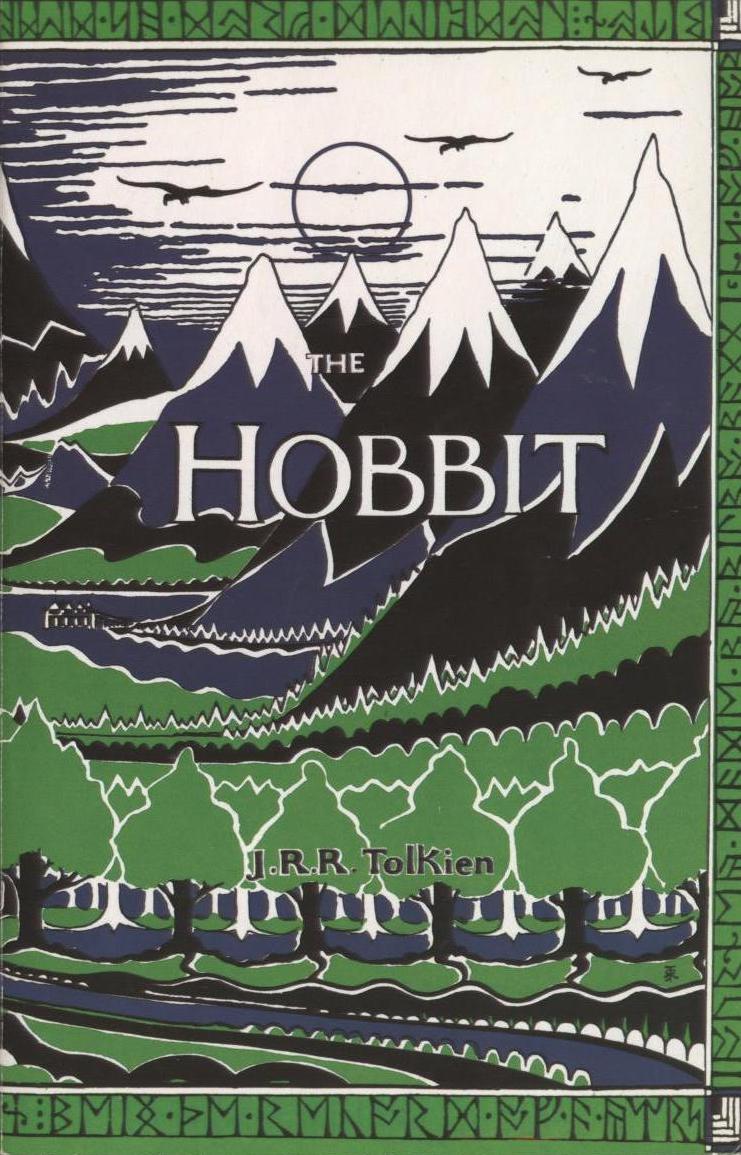
Storytelling ("The Hobbit" by J.R.R. Tolkein)
[With 2012 having seen both the 75th anniversary of Tolkien's The Hobbit and the release of The Hobbit: An Unexpected Journey in theatres, I thought it was time to sit down and, for the first time in my life, actually read the book.]
J.R.R. Tolkien's The Hobbit, a cornerstone of modern fantasy literature, lends itself nicely to cinematic adaptation. For one, its scenes of intensity and action are balanced nicely by chapters of prose that develop the story and introduce elements of Middle Earth without completely undermining the suspense that has just been built up. (Even the most unskilled screenwriter would have little problem keeping either aspect of the storyline in check.) Similarly, the extensive original mythology Tolkien uses to nurture much of the tension and conflict in his novel is balance rather skillfully with the storyline's familiarity: at its heart is the story of an everyman who transcends his ordinariness, engages in a seemingly impossible quest, and comes to recognize his own significance in a world that threatens to make him seem infinitesimal. It's Joseph Campbell cross-cultural myth-sharing at its most basic and pure--a fantasy homage to not only the story of Christ and his disciples, which Tolkien would further employ in The Lord of the Rings, but ancient epics and medieval texts that concern themselves with tales of ordinary men who must take up the mantle of warrior, sometimes to supreme results and sometimes to incredible, humbling failure.
Nevertheless, my fawning over these aspects of the novel doesn't mean that I found Tolkien's work to be all that good. In fact, after finishing it for the first time, I have to admit that I don't particularly like The Hobbit, nor do I find it that well written, its literary heredity aside. I have no issue with Tolkien predicating his novel on the idea that 13 dwarves, 1 hobbit, and 1 occasional wizard must journey to fight a talking dragon and reclaim the dwaves' lost kingdom, which that very same dragon took from them; it's his novel, he can do what he wants, and I'm the last person to begin treading on the freedoms and possibilities that come with being The Author. And truthfully, it's a concept ripe with possibility, much of which Tolkien does explore. But if it's that's the case, if you are an author making your own educated choices, and you choose to write a book about travellers journeying to slay a dragon, you cannot then resolve this conflict--the dragon slain, the kingdom restored--with 20% of the novel, or sixty-some pages, still to go, which you then fill with a new and until then completely nonexistent conflict.
But again, Tolkien is the storyteller, so perhaps--just perhaps--he's introducing this new conflict to serve as a lesson to the characters and readers alike. That would be fine, and there's actually a character--Thorin, rightful heir to the long-lost dwarf kingdom--who demands a little education before the novel concludes. In those last 60 pages, he becomes filled with inexplicable greed, refusing to return the riches pillaged from surrounding villages by the dragon Smaug until certain strange and childish requests are met...and even then, there is a suggestion that he'd much rather wage war to protect those plundered riches than hand over what amounts to 1/12 of the dragon's horde and preserve peace. He is also suddenly and maddeningly desperate for power, as symbolized by his search for a gem known as the Arkenstone--the Heart of the Mountain--and that power and greed corrupt him so thoroughly that he disowns Bilbo Baggins, the figure most responsible for the dragon's defeat and reclamation of his kingdom. These last 60 pages should have been a chance for Tolkien to explore the corrupting influence of money and power, which would not only allude back to the dragon itself--Thorin, in a sense, becoming his own personal Smaug--but also the character of Gollum, a hideous creature whose internal obsession with his precious ring could be seen as manifested in his hideous appearance.* Instead, Thorin is wounded in a battle with goblins, who have been absent for much of the novel, and makes up with Bilbo in less than a page without any sense of shame, awareness, or understanding of his errors. (The dwarf who succeeds Thorin, who just so happens to have been summoned by Thorin himself to defend the kingdom's vast wealth, wastes little time or energy returning the plundered riches.)
There are other aspects of The Hobbit that I found bothersome--Tolkien's constant breaks in the narration, for example, which he uses as opportunities to speak with the audience, are a pet peeve of mine but, in retrospect, were harmless and often a bit charming--but are ultimately not worth dissecting at length, as they mean very little to the novel as a whole. Overall, as much as I didn't take to the story, I will admit that I see where others might find something enjoyable, if not affirming and wonderful. However, it's some of those same people who'd I'd like to now discuss, as their interest in Tolkien and his novel are, without a doubt, a primary reason why I even took up this book in the first place, after casually avoiding it for the last 20 years of my reading-age life.
You see, besides the importance of Tolkien's novel to fantasy literature--and literature in general--and its popularity among readers of all ages, not to mention its place in curricula throughout the world as a novel that nourishes creative thinking and an appreciation for character and mythology in students, I was determined to read The Hobbit after seeing the first installment in Peter Jackson's trilogy...a cinematic endeavor that, from the moment it was announced, brought forth a level of vitriol that was astounding in its depth and persistence. More astounding, however, and the impetus for my making The Hobbit the first book I read in this new year, were the shouts of disloyalty, greed, and bastardization leveled at Jackson, his actors, and his crew. He would, these voices claimed, ruin The Hobbit by so departing from the original story that it irrevocably poisoned Tolkien's greatest literary legacy. And while I had never read the book of which these voices were so protective, I began to feel as though their reasons for attacking the film were, shall we say, shit. Empty, flat, hypocritical shit.
Before I explain, let me just confess: gripes like these are inevitable, and I understand that. In fact, I myself have done the same thing about film adaptations in the past, especially when they're books that were important parts of my life--more than just ink on paper, I guess you'd say--which I'm guessing is a major reason as to why Jackson's adaptation of The Hobbit received such an unusually high amount of scrutiny. After all, this is a book most people read when they're younger, and it's also probably one of the first full-length, adult-sized books they read, too--a major step in any reader's move towards adulthood and away from the Children's Corner of their local libraries and book stores. Not only that, it's a deeply personal story in that it asks young children to engage their minds fully in imagining these wild characters and their mythical, magical world. (There are, after all, no illustrations in Tolkien's book, apart from the maps of Middle Earth.) Children reading about Bilbo also may find strong similarities to their own lives; after all, Bilbo is an innocent, shy little hobbit who seems woefully unprepared for the terrifying journey ahead of him, a journey for which there is no preparation and no turning back. Any adolescent on the cusp of change, and especially the awkward changes of teenagedom, can identify completely with how Bilbo feels, especially when he confesses his feelings of worthlessness and inferiority around dwarves and wizards who are older, braver, and wiser...and who spend much of their time taking Bilbo for granted and denouncing him as an unprepared burden. It could make any preteen cry out in relief that someone, even a fictitious little halfling with big feet, could finally understand what they're experiencing.
So yes, a cinematic adaptation of The Hobbit has a much greater potential to offend than another, less significant book might. Had critics of Jackson cited these reasons, as I'm sure some did, as their primary cause of alarm, then there'd be no need for me to address it--I'd be sympathetic to their cause. However, these voices have raised another problem that, with book-to-film adaptations, gets raised a lot: that Jackson will change the original story in such a way that it will not be the same. Having seen the first installment of the trilogy, I can say that, yes, Jackson's changes do distort Tolkien's original story in ways that would probably have sent the author fuming in rage had he lived to see it. Some of these changes are done for obvious reasons--the inclusion of Radagast and his rabbit-sled, for one, helped organize some of the plot and add moments of action, regardless of how ridiculous it all was, and the character of the Necromancer was expanded beyond its place as an afterthought used to explain away Gandalf's lengthy but important absence--while others, like the pale orc, seem inexplicable or downright opportunistic.**
Even before Peter Jackson's film adaptation of The Hobbit had been released in theatres--in fact, even before Jackson had committed even one moment to actual film--a crusade was launched against everything associated with the as-yet-a-trilogy. These crusaders were varied in their reasons: some were steadfast Tolkien loyalists disenchanted since Jackson's Lord of the Rings films; some were those who believed in the purity and superiority of literature itself, regardless of author or genre; some took the opposite approach, believing in the inferiority of film regardless of its source material. And while a discussion about each of these different camps could be fruitful, it misses a point that these very crusaders also seemed to miss: Peter Jackson, in adapting Tolkien's novel rather than just filming it as written with no changes, was following the example of--gasp!--Tolkien himself, who borrowed heavily from ancient literature and the stories of ancient cultures and civilizations in writing The Hobbit and, in doing so, gave them a new life while preserving their original importance.
When we read The Hobbit, we are also reading the books of Tolkien's life and work. He lived in the classics, especially those of the Norse, and their influence permeates every clause, phrase, and paragraph of his fiction. You cannot follow Bilbo and the dwarves on their journey to defeat Smaug without also following behind Beowulf and his men as they fight Grendel, Grendel's mother, and eventually the dragon that claims Beowulf's life. (Any doubters may feel free to Google "The Hobbit and Beowulf," which will open the doors to at least five decades of academic research on the subject. In fact, this area of research is so old that much of its foundational work was published during Tolkein's life.) You cannot stand beside Bilbo without also standing beside King Arthur, the legendary sword-puller who Tolkien was writing about even before he wrote his novel about Bilbo. You cannot read about wizards and goblins and dwarves without reading also the early fairy tales that Tolkien would not have been able to avoid growing up a child of European history and literature. Even the names that so brighten Tolkien's mythology--Gollum, Gandalf, Dori, Fili, Kili, Middle Earth--owe themselves to a diverse collection of literary works, from old Norse sagas and mythological stories to 19th-century fantasy novels and children's tales. Every author borrows in their own way, consciously or not--we write in the inky veins of our ancestors--but Tolkien did so shamelessly...and for good reason: it was intentional, his ode and homage--and an expression of utmost love--towards the literature he so cherished.
But wait, those voices might say, that's completely different. Jackson isn't adapting The Hobbit into something different--he's making the exact same thing. There are no lose adaptations here, no Beowulf-becomes-a-halfling-style transformations. And those voices would be correct--this is not a fair comparison. But claiming that a film adaptation of a book, no matter how loyal to the source material, is not in itself a bastardization of that same material is foolish. After all, the practice of reading is a mental, illusory one: our minds construct the entire novel based on nothing more than ink and paper, and when the book is concluded, those fantasies are all we have--nothing physical beyond a well-worn collection of pages. We create the characters, how they look and sound and speak; we even imbue them with personality and motivation and complexity that a writer may only hint at or even ignore altogether. We imagine the landscapes, the homes, the food; we decide how the air smells, how blue the sky is, the length of the beards and hum of singing voices. Every paragraph is a thousand small, unthinkable decisions that our minds make without our conscious input, and those thousand little decisions build over the course of a book to create a tapestry of information so rich and thorough we can picture every tiny detail if we so choose.
Take, for instance, the moment when Smaug first reveals himself fully to Bilbo. Tolkien keeps his adjectives in check, offering us a very basic description of the creature...but that does not stop our minds from filling in the gaps. As I read, Smaug's scales became a golden brown--the color of a sunflower that's been dried by time and the sun. His voice was deep and familiar, most likely inspired by Christopher Lee's Jabberwocky, even though Tolkien does not offer one syllable explaining the tempo, timber, or range of Smaug's voice. And the jewels that encrusted his chest, I could picture all of them--read, green, blue--all shimmering across the span of his massive underside. Some were rectangular, some were trapezoidal, some round, some triangular...and there were dozens, if not hundreds. His head sprouted horns--four, two on each side, one big and one small--and his teeth were perfectly white, a contrast to the dirty-muddy-black of his claws. I imagine it all--Smaug himself, as well as the mountains of gold around him, the ashen gray pillars of the mountain castle, the darkness of the empty hall, the dust that clung to the air--and only later realized how little actual conscious input I had in the whole process.
When a book is made into a film, all of those small details--the dozens or hundreds or thousands of them--become irrelevant, almost as though we'd never actually read the story. We no longer have control over the color of the sky, the length and shade and style of the beards, the sound of a song being sung, the foods that are laid out upon a hobbit's table. We are told now how the dwarves sound, what their personalities are like, what motivates them...and if we don't like it, we have no recourse in the matter other than to stand and leave the theatre. Which is never the option of choice. The very act of making a book into a film is the first step of disloyalty towards a text, regardless of how "loyal" the finished product may be towards its original source.
To claim that Peter Jackson, in making changes to The Hobbit for his film version, is corrupting Tolkien's novel is, technically, correct; to say that those changes are a reason to avoid the film and disparage those involved in its creation is idiotic. We do not avoid the reproductions of great works of art because they someone take away from the original work; instead, we accept them as their own individual works of expression and interpretation, maybe even offering us a new perspective on a painting or sketch we thought we'd become familiar with, and we appreciate the original anew. We do not avoid poetry readings because the speaker may recite a favorite poem in a different way, emphasize the wrong word or pause for a second too long at certain points; instead, we accept that each lover of poetry interprets their favorite poems in their own way, sees the rhymes and beats and line breaks through their own sense of creation, and we smile along at the beauty of the written word without feeling as though the entire event denigrates the poems. And yet, the act of taking the written word and making it visual is seen by some as a travesty beyond compare. Are there aspects of Jackson's film worthy of scorn and ridicule? Of course there are, just as there are issues to be found in every film. But to see his desire to interpret The Hobbit in his own way as an attack on Tolkien's work, or as an undermining of what his literature is supposed to stand for, is to reveal that you understand nothing at all. In doing so, you become little more than a tiny hobbit standing at the foot of a dragon you hope to slay. But the kingdom you hope to reclaim is not yours, the king who once stood in its doors has long since left its halls, and you fight for a treasure that is merely a fantasy. A rich, interesting, and personal fantasy, yes, but a fantasy nonetheless.
Interesting additional sites:
1. http://faculty.uca.edu/jona/second/hobbeow.htm
2. http://www.thebookladysblog.com/2011/08/17/the-top-ten-books-that-influenced-j-r-r-tolkien/
3. http://blastr.com/2012/10/tolkiens-never-before-pub.php
____
*It would also have, coincidentally, foreshadowed the internal struggles of Frodo Baggins in Tolkien's future novel, which he hadn't yet begun writing.
**Another change, the inclusion of Saruman, has absolutely no apparent purpose to the story other than to give Christopher Lee another chance to appear in Jackson's adaptations, which is all the reason I'd need to be fine with it, to be honest. I'm a die-hard fan of Christopher Lee, who is now in his 10th decade and still possessing the gravitas--and thundering voice--that has made him such a long-lasting and long-respected actor. Besides that, Lee is a fan and ardent defender of Tolkien's work, and his exclusion--especially after the indignity he suffered after his scenes were cut from The Return of the King--would have been sacrilegious.
Sunday, December 30, 2012
The Books of 2012
When I was a teenager, I always had a book with me, the bigger the better. I still remember reading both Roots and Battlefield Earth simultaneously when I was a junior in high school, and carrying those two books with me wherever I went--about 1700 pages of literature total--drew quite a few comments from my teachers. Unfortunately, my hunger for reading fell away during college, where professors emphasized analyzing literature over enjoying it; the teenager who once read dozens of books in an average school year was suddenly the twenty-something undergrad who read barely two or three a semester, and even then found little enjoyment in them. Even after graduation, during my first two years of full-time teaching, I was working 14-16 hours a day, which left little time for pleasure reading.
However, now that I'm in my fourth year of teaching and my schedule has evened out--though I still put in upwards of 12 hours a day at work, 6am to 6pm--I can't get enough to read, and it doesn't matter the subject, style, or author. This year alone, I read books about forensic science, Theodore Roosevelt, zombified mothers, wormholes, demonic possession, the Trojan War, South Korea, Walter Cronkite, Superman, a World War II submarine, homicidal cats, dystopian teen prisons, Mumbai slums, Saturday Night Live, gay marriage, and so on. There were graphic novels, biographies, memoirs, poetry collections, short story anthologies, children's books, comic books, young adult novels, works of narrative nonfiction, and immortal works of literature. And they came from everywhere, too: India, Spain, Colombia, South Korea, the United States, England, France, Chile, and Iraq. It was a prodigious year, to be sure, and one that I hope to trounce next year.
Below are the books I read or re-read (*) in 2012, in order. Some of my favorites, for those who are curious, are shown above.
- The Devil and Sherlock Holmes: Tales of Murder, Madness, and Obsession (David Grann)
- Ghosty Men: The Strange but True Story of the Collyer Brothers and My Uncle Arthur, New York's Greatest Hoarders (Franz Lidz)
- The Dictator's Handbook: Why Bad Behavior is Almost Always Good Politics (Bruce Bueno de Mesquita and Alastair Smith)
- How to Rule the World: A Handbook for the Aspiring Dictator (Andre de Guillame)
- Blankets (Craig Thompson)
- Persepolis: The Story of a Childhood (Marjane Satrapi)
- The Turk: The Life and Times of the Famous Eighteenth-Century Chess-Playing Machine (Tom Standage)
- Pyongyang: A Journey into North Korea (Guy Delisle and Helge Dascher)
- Nothing to Envy: Ordinary Lives in North Korea (Barbara Demick)
- Night Shift* (Stephen King)
- Pulphead: Essays (John Jeremiah Sullivan)
- Lord of the Flies* (William Golding)
- The Billionaire's Vinegar: The Mystery of the World's Most Expensive Bottle of Wine (Benjamin Wallace)
- Machine of Death: A Collection of Stories About People Who Know How They Will Die (North, Bennardo, and Malki!, editors)
- Hunger Games (Suzanne Collins)
- Anthem* (Ayn Rand)
- Cosmopolis (Don DeLillo)
- Cloud Atlas (David Mitchell)
- Bystanders: Conscience and Complicity During the Holocaust (Victoria Barnett)
- Night* (Elie Wiesel)
- Rule and Ruin: The Downfall of Moderation and the Destruction of the Republican Party, From Eisenhower to the Tea Party (Geoffrey Kabaservice)
- The Poisoner's Handbook: Murder and the Birth of Forensic Evidence in Jazz Age New York (Deborah Blum)
- Losing My Faculties: A Teacher's Story (Brendan Halpin)
- Wild: From Lost to Found on the Pacific Crest Trail (Cheryl Strayed)
- The Fried Twinkie Manifesto: And Other Tales of Disaster and Damnation (Ryan Moehring)
- Charlatan: America's Most Dangerous Huckster, the Man Who Pursued Him, and the Age of Flimflam (Pope Brock)
- Do Not Ask Us What Good We Do: Inside the U.S. House of Representatives (Robert Draper)
- Here, Bullet: Poems (Brian Turner)
- August: Orange County (Tracy Letts)
- All My Friends Are Dead (Avery Monsen and Jory John)
- The Taking Tree: A Shrill Parody (Shrill Travesty and Lucy Ruth Cummins)
- Go the F**k to Sleep (Adam Mansbach and Ricardo Cortes)
- That's Not Your Mommy Anymore: A Zombie Tale (Matt Mogk and Aja Wells)
- Cronkite (Douglas Brinkley)
- Skipping Towards Gomorrah (Dan Savage)
- The Partly Cloudy Patriot (Sarah Vowell)
- Endgame: Bobby Fisher's Remarkable Rise and Fall--from America's Brightest Prodigy to the Edge of Madness (Frank Brady)
- Trout Fishing in America (Richard Brautigan)
- Magic Hours: Essays on Creators and Creation (Tom Bissell)
- The Old Man Who Read Love Stories (Luis Sepulveda)
- That Night (Alice McDermott)
- The Stupidest Angel (Christopher Moore)
- Grant's Final Victory: Ulysses S. Grant's Heroic Last Year (Charles Bracelen Flood)
- The Best Man (Gore Vidal)
- The Committment: Love, Sex, Marriage, and My Family* (Dan Savage)
- The Diving Bell and the Butterfly: A Memoir of Life and Death (Jean Dominique Bauby; Jeremy Leggatt, trans.)
- HHhH (Laurent Binet; Sam Taylor, trans.)
- Middlesex (Jeffrey Eugenides)
- England Under Hitler (Comer Clarke)
- Book (Robert Grudin)
- So You Created a Wormhole: The Time Traveler's Guide to Time Travel (Phil Hornshaw and Nick Hurwitch)
- It's Even Worse Than it Looks: How the American Constitutional System Collided with the New Politics of Extremism (Thomas E. Mann and Norman J. Ornstein)
- Skinny Dip (Carl Hiaasen; audio book, read by Barry Bostwick; abridged)
- The Book Thief (Markus Zusak)
- The Violinist's Thumb: And Other Lost Tales of Love, War, and Genius, as Written by Our Genetic Code (Sam Kean)
- Kingdom Come (Mark Waid and Alex Ross)
- Fatal Dive: Solving the World War II Mystery of the USS Grunion (Peter F. Stevens; audio book, read by Robertson Dean)
- Leviathan (Scott Westerfeld)
- The Lost Symbol (Dan Brown; audio book, read by Paul Michael)
- Where Things Come Back (John Corey Whaley)
- Lost in Shang-Ri La: A True Story of Survival, Adventure, and the Most Incredible Rescue Mission of World War II (Mitchell Zuckoff; audio book, read by the author)
- The Absolutely True Diary of a Part-Time Indian (Sherman Alexie)
- Behemoth (Scott Westerfeld)
- First Day on Earth (Cecil Castellucci)
- The Ticking (Renee French and Chris Staros)
- American Born Chinese (Gene Luen Yang)
- Tricks (Ellen Hopkins)
- Pitch Black (Youme Landowne and Anthony Horton)
- Demo: The Collected Edition (Brian Wood and Becky Cloonan)
- The Oath: The Obama White House and the Supreme Court (Jeffrey Toobin)
- Stargirl* (Jerry Spinelli)
- Me the People: One Man's Selfless Quest to Rewrite the Constitution of the United States of America (Kevin Bleyer)
- Tim Gunn's Fashion Bible (Tim Gunn)
- Goliath (Scott Westerfeld)
- How to Tell if Your Cat is Plotting to Kill You (Matthew Inman and The Oatmeal)
- Goliath (Tom Gauld)
- World War Z (Max Brooks)
- Drift: The Unmooring of American Military Power (Rachel Maddow)
- On Bring Different: What it Means to be Homosexual (Merle Miller)
- Colonel Roosevelt (Edmund Morris)
- Lost at Sea: The Jon Ronson Mysteries (Jon Ronson)
- How to be a Person: The Stranger's Guide to College, Sex, Intoxicants, Tacos, and Life Itself (Editors, the Stranger)
- Scorch Atlas (Blake Butler)
- Bonechiller (Graham McNamee)
- Oddly Normal: One Family's Struggle to Help Their Teenage Son Come to Terms with His Sexuality (John Schwartz)
- The Curiosities: A Collection of Stories (Brenna Yovanoff, Tessa Gratton, and Maggie Stiefvater)
- The Odyssey* (Homer; graphic novel illustrated by Gareth Hinds)
- Lockdown: Escape from Furnace 1 (Alexander Gordon Smith)
- The Silver Pony: A Story in Pictures (Lynd Ward)
- Chicken With Plums (Marjane Satrapi)
- Saturday Night: A Backstage History of Saturday Night Live (Doug Hill and Jeff Weingrab)
- Road to Perdition (Max Allan Collins)
- Into the Wild (Jon Krakauer)
- Behind the Beautiful Forevers: Life, Death and Hope in a Mumbai Undercity (Katherine Boo)
- Down the Rabbit Hole (Juan Pablo Villalobos; Rosalind Harvey, trans.)
- Of Love and Other Demons (Gabriel Garcia Marquez; Edith Grossman, trans.)
Saturday, December 29, 2012
Children ("Down the Rabbit Hole" by Juan Pablo Villalobos)
In 2010, Emma Donoghue's novel Room caused a minor sensation among critics and readers alike--by their own admissions, neither group had ever really read anything like it. The story of a mother and son kept imprisoned in an isolated room by a kidnapper known only as Old Nick, the story is told from the point of view of the child, his situation unclear at first. He speaks as you'd expect all five year-olds to speak, in riddles and personifcations that are less about adolescent confusion and just simply about an immature mindset, one built half on misunderstandings about the world--referring to objects as though they were living proper nouns--and half on his mother's abstract ways of explaining away their god-awful situation. Had Donoghue written the novel from any other other perspective--the mother's, Old Nick's, even a detached and dispassionate third-person--Room would have lost the uniqueness and voice that led it to become such a bestseller in the first place.
Juan Pablo Villalobos employs the same technique in Down the Rabbit Hole, his first novel. And while Villalobos had quite a few impediments to gaining the same amount of success and popularity as Donoghue--he didn't have an established readership or credibility with critics, his novel came in at only 70 pages, and it was first published in Spain, meaning the time spent on translations caused it to be published after Donoghue's novel, even though it appeared in print the very same year--he manages to use the technique much more effectively than Donoghue.
Told from the point of view of Tochtli, a nine year-old Mexican boy, Down the Rabbit Hole starts in much the same way as Room: from the little information we are given outright, we know that our narrator is being kept in seclusion by an older man whose identity is sketchy at first; he follows a strict routine within the boundaries of his home; his mind is allowed to run free with fantasy; and the outside world, available only through a television set, is kept far away. The boy's one persistent dream is to have his very own Liberian pygmy hippopotamus, and he dreams of this little achievement between lessons with his teacher--Mazatzin--and repeated viewings of the same samurai films. As he does, we slowly piece together the reasons behind his seclusion--his father is a violent drug kingpin--and how his father's depravity--a shed full of loaded guns, a running menagerie of prostitutes, violent beheadings, bribing government officials--is treated as little more than the curious eccentricities of a dad who is otherwise doting and compassionate towards his son.
Unlike Donoghue's novel, Down the Rabbit Hole is short--a decision that keeps the first-person technique fresh. In Room, which clocks in at almost 400 pages, the first-person point-of-view becomes tiresome after a while; after all, Donoghue is keeping her readers perpetually trapped in the simplified world of an adolescent. Villalobos, on the other hand, gives us just enough of Tochtli to build a clear, coherent, and interesting story before it becomes redundant and frustrating. By the time the novel closes, we've come to understand Tochtli's life--and the life of his father--seen him pursue his hippo dream to its inevitable, disappointing failure, and been offered enough foreshadowing about what is to come--two taxidermied hippo heads, the significance of golden crowns, a samurai-film sacrifice--that we understand where the story is going without also having to be led there. Villalobos manages to use a literary technique long enough to craft a wonderful little story without the technique--and, in a sense, the narrator--overstaying its welcome.
Subscribe to:
Posts (Atom)